Guide
The period between commercial agreement and closing is where maritime deals most often break down — not because of dramatic discoveries, but because of operational friction. A well-structured data room is the difference between a deal that closes and one that stalls.
Key Takeaways
Why it matters
In maritime transactions, due diligence is not a formality. It is the transaction itself. The period between commercial agreement and closing is where maritime deals most often break down — not because of dramatic discoveries, but because of operational friction:
A buyer evaluating a vessel, fleet, or newbuild program is effectively reconstructing the operational history and technical condition of a floating industrial asset worth tens or hundreds of millions of dollars. The data room becomes the source of truth.
Well-run maritime transactions maintain a live operational data room long before a sale process begins. When diligence starts, the majority of documents are already structured, indexed, validated, and permission-controlled. That operational readiness sends a powerful signal: this owner, operator, yard, or sponsor is professionally managed.
In practice, organized diligence:
Key Insight
Build the maritime data room before the transaction process begins.
The worst time to organize the following is during active due diligence while brokers, lawyers, banks, surveyors, and counterparties are already waiting:
The best time is months before the process starts. Modern maritime transactions increasingly require continuously maintained digital infrastructure — not static Dropbox folders assembled at the last minute.
Structure
A complete maritime transaction data room spans six primary sections, each with sub-categories covering every document type reviewers expect to find.
Corporate Documentation
Vessel Transaction Documentation
Regulatory & Flag Documentation
This is typically the largest and most critical section.
Vessel Technical Files
Maintenance & Operational Records
Surveys & Inspection Records
Classification Society Records
Compliance Documentation
For older vessels, buyers frequently spend disproportionate time evaluating deferred maintenance risk hidden inside class recommendations and survey histories.
Chartering
Revenue & Commercial Operations
Insurance
Vessel Financial Documentation
Financing
Transaction Modeling
For newbuild programs, the data room becomes significantly more document-intensive.
Shipyard & Contractual
Construction Management
Engineering & Design
A major challenge in newbuild transactions is controlling document version integrity across owners, yards, class societies, suppliers, and technical consultants. Without structured revision management, disputes emerge quickly.
Role-specific workflows
Every role in the transaction interacts with the data room differently. Explore how Marintel surfaces the right documents for each party.
Best practices
Traditional shared folders are increasingly insufficient for large maritime transactions. Modern maritime diligence requires:
The future maritime data room behaves less like cloud storage and more like operational transaction infrastructure.
Use clear naming conventions:
[Section]-[Vessel]-[Document]-[Revision]-[Date]
03-Technical-MV_Athena-GA_Drawing-RevC-2026-04.pdf 05-Class-MV_Athena-Survey_Status-2026Q1.pdf 07-Newbuild-Hull_812-Change_Order_14-RevB.pdf FINAL_v2_REAL_FINAL.pdf latest_new_one.xlsx Every maritime data room should contain:
Surveyors, lawyers, banks, brokers, and technical consultants all navigate the room differently. A structured index dramatically reduces transaction friction.
Different stakeholders require different visibility:
Stakeholders
Required controls
Transaction risk
These are the categories that most frequently stall deals — or kill them.
Creates uncertainty around vessel condition and deferred CAPEX exposure.
Buyers cannot assess operational reliability or lifecycle costs.
Conflicting technical drawings create engineering and liability risk.
Cost overruns and specification disputes emerge during delivery.
Commercial assumptions no longer align with operational reality.
Unknown liabilities create financing and underwriting concerns.
Technical due diligence cannot validate current vessel condition.
Technical reviewers waste days reconstructing basic chronology from email chains.
FAQ
Ideally long before a transaction process begins. Operationally mature owners and yards maintain continuously updated transaction-ready infrastructure rather than building diligence folders reactively.
Depending on transaction type:
Maritime transactions combine legal diligence, industrial engineering review, operational performance analysis, environmental compliance, global regulatory complexity, and multi-jurisdiction ownership structures. The asset itself is a moving industrial system operating globally under multiple overlapping regulatory frameworks.
Summary
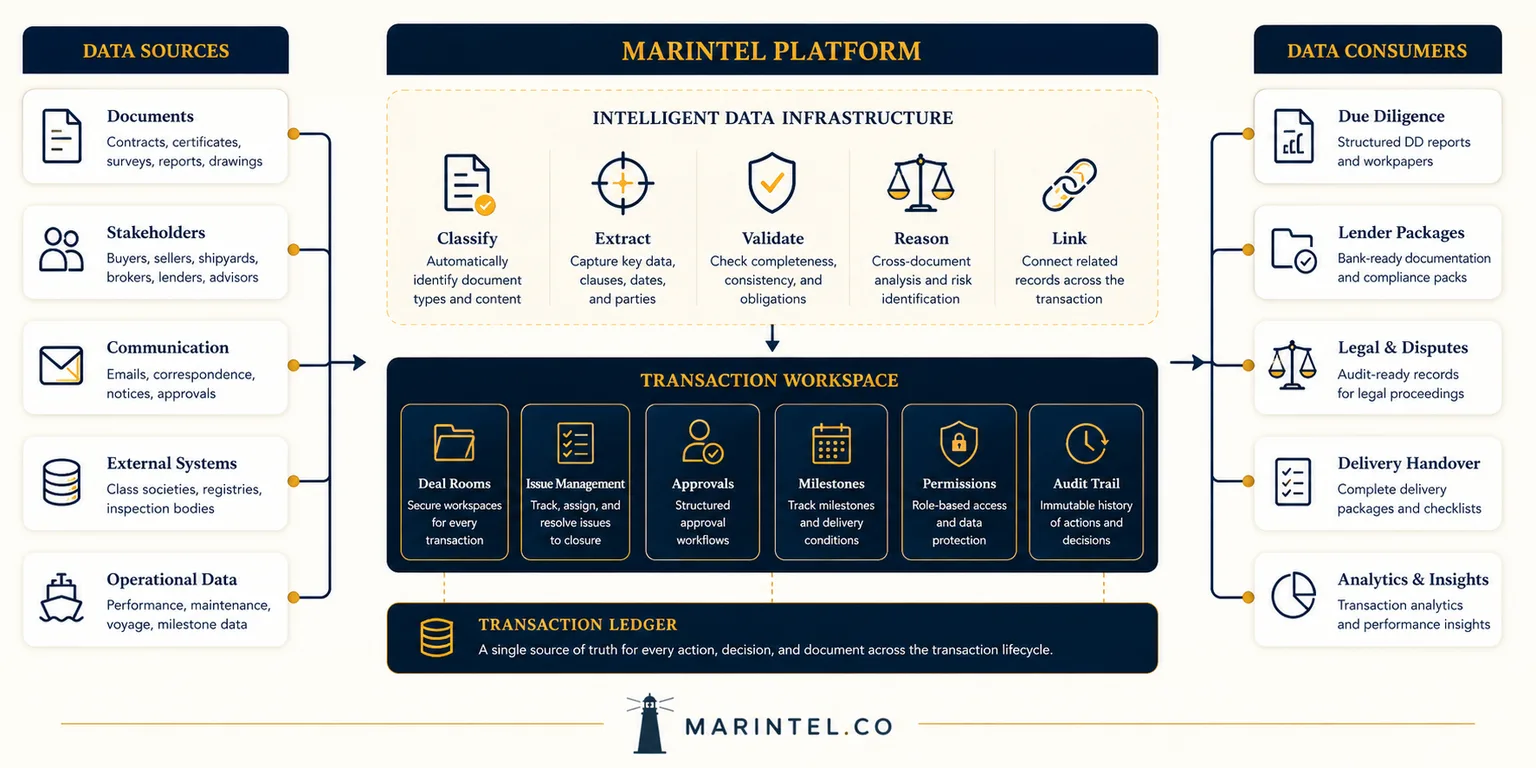
A maritime transaction data room is not a document repository. It is the operational backbone of vessel acquisitions, fleet transactions, financing events, and newbuild programs.
Well-structured maritime data rooms:
The future of maritime transactions will increasingly depend on intelligent data room infrastructure capable of:
In maritime S&P and newbuilds, the quality of the data room increasingly determines the quality — and speed — of the transaction itself.
AI-powered document validation, structured data rooms, and cryptographic closing artifacts — built for how ship deals actually close.
Continue reading
Explore the full transaction lifecycle with Marintel's companion guides.
By role
Platform advantages