
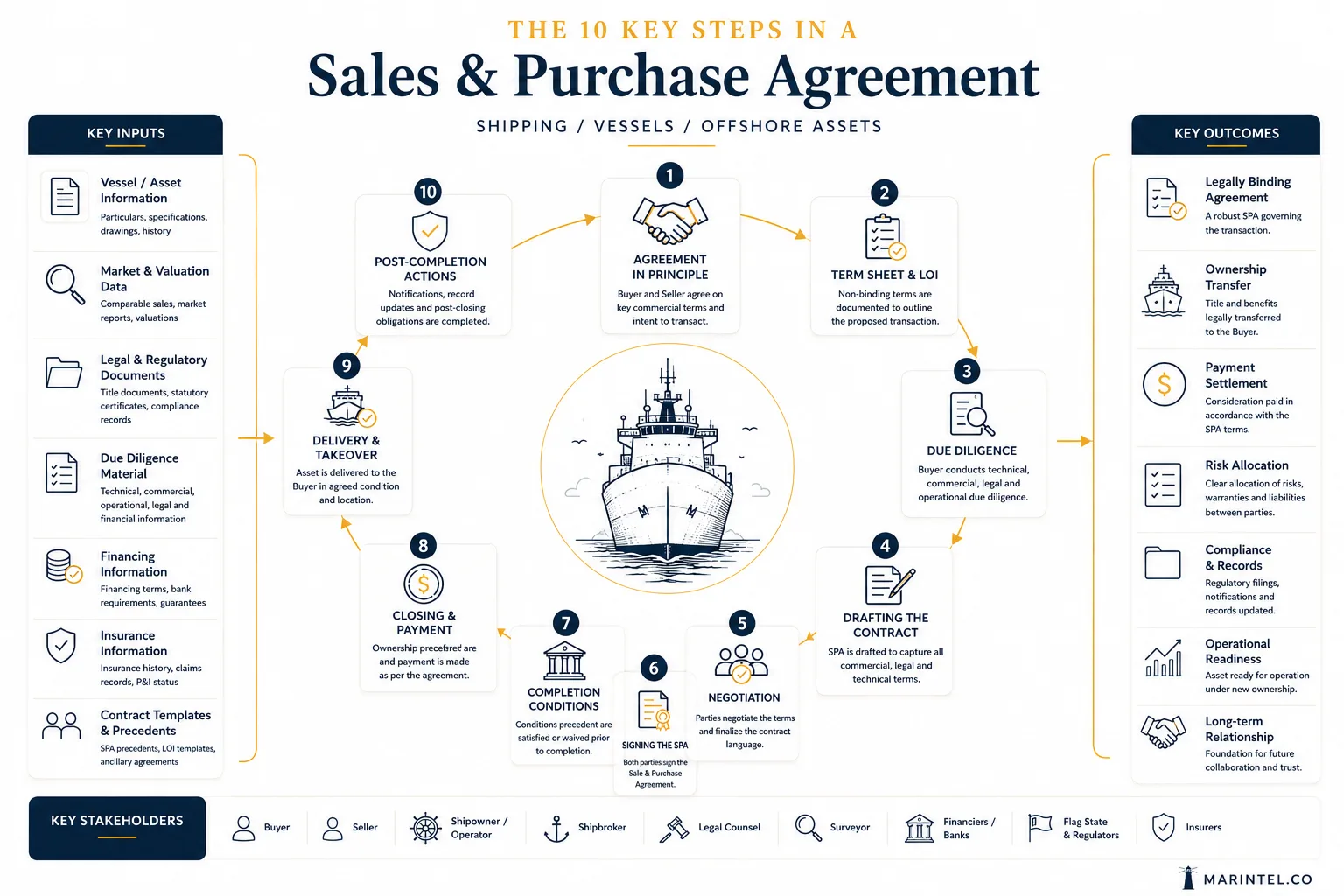
How to use this guide
This is a long, structured reference. You can read it cover to cover (recommended for first-time buyers and sellers), or jump straight to a phase or document you need.
- New to S&P? Read the Quick Reference Timeline and Before You Start sections, then walk through each phase in order.
- Need a specific document? Use the table of contents or search for the document ID (e.g., D170 for Bill of Sale).
- Working a non-merchant vessel? Each phase has expandable asset-type sections for offshore production, drilling, passenger, and inland transactions.
Table of contents
- Quick Reference Timeline
- Before You Start
- Phase SP-1: Pre-MOA / Due Diligence
- Phase SP-2: MOA Signing & Deposit
- Phase SP-3: Subjects Period
- Phase SP-4: Pre-Delivery / NOR
- Phase SP-5: Closing / Delivery
- Phase SP-6: Post-Closing
- Phase SP-7: Post-Closing Tail
- Closing Day Deep Dive
- Marintel-Generated Artifacts
- Common Failure Modes
Quick Reference Timeline
A standard merchant S&P deal moves through seven phases over 4-8 weeks. Larger transactions, complex financings, or flag changes can extend this; en-bloc fleet sales compress some phases by running them in parallel.
| Phase | Name | Typical duration | Key event |
|---|---|---|---|
| SP-1 | Pre-MOA / Due Diligence | 1-3 weeks | Inspection completes; price agreed in principle |
| SP-2 | MOA Signing & Deposit | 1-3 days | MOA executed; deposit lodged in escrow |
| SP-3 | Subjects Period | 5-14 days | All subjects lifted (inspection, finance, BOD) |
| SP-4 | Pre-Delivery / NOR | 1-7 days | NOR ready to tender; CPs satisfied |
| SP-5 | Closing / Delivery | Same day | NOR tendered; PODA signed; title transfers |
| SP-6 | Post-Closing | 1-4 weeks | New flag registered; mortgage filed; insurance perfected |
| SP-7 | Post-Closing Tail | 1-6 months | Deferred originals received; final reconciliations |
Before You Start: Predicates and Asset Types
Before opening a data room, two pieces of information determine what documents will apply: the vessel type and three deal-level predicates. Marintel uses these to filter the document requirements automatically.
The six predicates
| Predicate | Values | What it determines |
|---|---|---|
vessel_type | tanker, bulk, container, general_cargo, chemical, gas, passenger, offshore, reefer | Vetting and particulars documents |
asset_class | merchant_trading, offshore_production, drilling, inland, passenger | Regulatory regime and contract base |
financed | yes, no | Loan, mortgage, RG, AML/KYC documents |
flag_change | yes, no | Deletion certificates, new registration, mortgagee consent |
sub_type_filters | dp_equipped, ice_class, modu_classed, igc_carrier, helideck, crane_equipped, etc. | Specific physical-feature certifications |
operating_jurisdiction | US, UK_offshore, NO_offshore, BR_offshore, EU, SG, CN, RU, Persian_Gulf, Inland_EU, Inland_US | Jurisdiction-specific compliance documents |
Set these correctly at deal creation and the workflow shows you exactly the documents you need. Set them incorrectly and you'll see irrelevant requirements or miss real ones.
Flag change: a special case
If the buyer intends to change the vessel's flag at closing (common for cross-border transactions), flag_change = yes. This triggers a substantial additional document set: the prior flag's Deletion Certificate, new flag's Application for Registration, Mortgagee Consent to flag change (if financed), apostille requirements on multiple documents, and timing coordination between the two registries.
Flag-change deals routinely take 2-4 weeks longer than same-flag deals. Budget accordingly.
Asset type variations
Most S&P deals are merchant trading (tankers, bulkers, containers, general cargo). The phase structure described in this guide is written for that case. Non-merchant deals have meaningful variations - documented in collapsible sections within each phase below.
Offshore Production assets (FPSO / FSO / FLNG)
Offshore production assets are typically held under long-term oil-major charters (Petrobras, Equinor, BP, etc.). The S&P transaction usually involves transfer of a chartered asset rather than open-market sale.
Key differences from merchant S&P:
- EPCI Contract replaces SBC where the vessel is being converted
- Charter / Lease Contract with the oil major becomes a critical attachment
- Field Development Plan reference required for asset-location context
- Mooring System Certificate (turret, spread mooring, dynamic positioning) attached
- Topsides Design Approval needed for production equipment
- MWS (Marine Warranty Surveyor) reports for installation phases
- Decommissioning bond / plan often regulator-required
- Typical deal complexity: 12-20 weeks instead of 4-8 weeks
- Q88 and SIRE not applicable; CDI may apply if cargo-handling
Drilling Rigs (drill ships / semi-submersibles)
Drilling rigs operate under MODU Code (IMO Mobile Offshore Drilling Units), not standard SOLAS. S&P transactions are typically between drilling contractors or between operators and contractors.
Key differences:
- MODU Code Certificate replaces some standard SOLAS certificates
- Drilling Contract (with E&P operator) replaces or supplements MOA
- Well Control Equipment Certification (BOP, riser) required
- Variable Deck Load Certificate documented
- DP Capability Plot / DP Class Certificate (DP-2 or DP-3 typical)
- Coast Guard COCs (for US GoM operations)
- Operator-specific Safety Case (UK HSE, NORSOK)
- Q88 / SIRE not applicable
- Typical deal complexity: 8-16 weeks
Passenger Ships (cruise / ferry / Ro-Pax / HSC)
Passenger ships have stringent statutory regimes (SOLAS Chapters II-1 and III for damage stability, MARPOL, plus passenger-specific certificates).
Key differences:
- Passenger Ship Safety Certificate (PSSC) replaces Cargo Ship Safety Certificate
- Damage Stability Information Booklet required
- Stability Calculations under SOLAS 2009/2017 damage scenarios required
- Lifesaving Appliance Plan & Capacity Calculation required
- Muster List & Emergency Plan attached
- Onboard Medical Center Equipment List
- Public Health Certificate (USPH / Vessel Sanitation Program) for vessels calling US ports
- Concessions / Cabin / F&B Service Agreements (cruise ships) become commercial attachments
- HSC Code Certificate for high-speed craft
- Q88 / SIRE not applicable
- Typical deal complexity: 6-12 weeks
Offshore Support (AHTS / PSV / OSV / CTV / SOV)
OSVs typically operate under BIMCO SUPPLYTIME 2017 (or WINDTIME for wind-farm SOV/CTV) rather than charter-free trade.
Key differences:
- SUPPLYTIME 2017 charter party may be assigned with vessel
- WINDTIME charter for offshore wind operations
- DP Class Certificate (DP-1 / DP-2 / DP-3) required where applicable
- Fi-Fi (Fire Fighting) Class Notation Certificate where classed
- Oil Recovery / Oil Spill Response Equipment List (for spill-response vessels)
- Bollard Pull Certificate (AHTS specific)
- Crane Certification & Lifting Plan (for PSV / construction vessels)
- HUET Training Records (operational handover for crew)
- Typical deal complexity: similar to merchant (4-8 weeks)
Inland Vessels (CESNI / Subchapter M)
Inland regimes (EU CESNI, US Coast Guard Subchapter M) differ materially from deep-sea SOLAS-based regulations.
Key differences:
- Inland Navigation Certificate replaces standard flag registration
- ADN Certificate (Dangerous Goods - inland) where carrying dangerous cargo
- Inland-Specific Tonnage Certificate (CCR / RNR for Rhine; equivalent for other rivers)
- Bridge Air-Draft Certificate often required
- Bill of Sale conventions differ (civil-law CESNI rather than common-law)
- Class society interaction patterns differ
- Typical deal complexity: shorter (3-6 weeks) due to simpler regulatory regime
Phase SP-1: Pre-MOA / Due Diligence
When this happens: Weeks -8 to -2 before closing. The buyer has identified a vessel; the seller has decided to entertain offers. Brokers may be involved. Price is being discussed but no binding agreement exists.
Goal: Buyer satisfies themselves the vessel is what's claimed. Seller establishes the vessel is worth the asking price. Both sides confirm regulatory status, vetting standing, ownership chain, and material condition.
Phase gate to advance: Both parties agree to proceed to MOA execution.
Mandatory documents (SP-1)
These documents must be in Accepted state before the phase can advance. In Marintel terms, they're rated M for SP-1.
D024 - Classification Certificate (Full Term)
- Purpose: The classification society's confirmation that the vessel meets its class rules. Without it, the vessel cannot trade.
- Contents: Certificate number, vessel IMO and name, class society (DNV, ABS, LR, BV, ClassNK, KR, RINA, CCS, IRS, or other), class notation (e.g., "+A1 Bulk Carrier BC-X"), issue and expiry dates, place of issue, surveyor name, any conditions of class or recommendations.
- Issued by: Classification society. Received by: Owner, all transaction parties.
- Why mandatory at SP-1: A buyer cannot proceed without verifying class is in order. A vessel with conditions of class trades at a discount; a vessel without valid class doesn't trade at all.
D025 - Special Survey Report (SS)
- Purpose: Class society's 5-yearly comprehensive vessel survey. Confirms hull, machinery, and equipment to class.
- Contents: Survey results, NCRs raised and closed, rectifications, surveyor sign-off.
- Issued by: Classification society. Why mandatory at SP-1: SS results affect vessel value and trading capability. A vessel with major SS findings affects price materially.
D031 - Class Status Report / Class Maintenance Confirmation
- Purpose: Current snapshot of class standing - all surveys due, all surveys closed, all conditions, recommendations, and memoranda.
- Issued by: Classification society. Why mandatory at SP-1: Even if individual cert and survey reports are clean, the full class status report can reveal pending issues.
D060 - Q88 (tankers)
- Purpose: The standardised tanker particulars document. The "passport" of every tanker, structured around 88 questions covering vessel specifications, equipment, and operational data.
- Contents: Vessel particulars, tank configuration, cargo handling equipment, pumps and piping, gas systems (where applicable), inert gas systems, mooring, communications.
- Issued by: Vessel operator / manager. Why mandatory at SP-1: Tankers cannot trade without an up-to-date Q88. Buyers will not progress without seeing one.
- Asset class: merchant_trading only (tankers, chemical tankers, gas carriers).
D061 - Vessel Particulars Sheet (non-tanker)
- Purpose: Non-tanker equivalent of the Q88. Less standardised but performs the same function - the vessel's specification document.
- Contents: Hull dimensions, tonnage, cargo capacity, cargo handling, propulsion, fuel consumption, manning, classification, regulatory certificates.
- Issued by: Vessel operator / manager. Why mandatory at SP-1: For non-tankers (bulk, container, general cargo), this is the baseline information set buyers and lenders require.
- Asset class: merchant_trading (non-tanker).
D081 - Permanent Certificate of Registry
- Purpose: The flag state's permanent registration document. Definitive proof of registered ownership and flag state.
- Contents: Registry number, vessel IMO and name, flag state, port of registry, registry office, registered owner entity name and jurisdiction, issue date, gross and net tonnage, encumbrances noted (mortgages and liens).
- Issued by: Flag state registry. Why mandatory at SP-1: The certificate is the legal document proving the vessel exists, is registered, and identifies its registered owner. The buyer needs this to verify the seller has authority to sell.
D089 - Transcript of Registry / Encumbrance Certificate
- Purpose: Detailed list from the flag state of every registered interest in the vessel (mortgages, liens, attachments).
- Contents: All current mortgages by rank, all historical mortgages with discharge dates, any registered liens or attachments.
- Issued by: Flag state registry. Why mandatory at SP-1: Buyer must verify the title is clean (or will be by closing). A vessel with multiple ranked mortgages requires specific discharge sequencing.
D130 - Owner's Inspection Report (pre-MOA)
- Purpose: The buyer's surveyor inspection report of the vessel, conducted before MOA signing.
- Contents: Hull inspection, machinery survey, cargo space inspection, deck equipment review, observations and recommendations, photographic record where applicable.
- Issued by: Inspector engaged by buyer. Why mandatory at SP-1: Without buyer's own inspection, MOA execution would lack the standard "subject inspection" mechanism's foundation.
D240 - Sanctions Screening Confirmation (partner-provided)
- Purpose: Confirmation that all counterparties (seller, broker, manager, payment-side entities) have been screened against sanctions lists.
- Contents: Counterparty entity name, jurisdiction, screening provider used, screening date, screening result (clear / hit-review / hit-block), screening notes.
- Issued by: Provider (Pole Star, Sayari, Refinitiv, Windward, or internal compliance). Recorded in Marintel via manual confirmation gate. Why mandatory at SP-1: Banks will not finance a deal without sanctions clearance on all counterparties; lawyers will not opine on a deal without it.
Recommended documents (SP-1)
These documents are strongly recommended but not strict phase gates.
- D006 Charter Party Description - existing charter terms attached for income context (where vessel is sold with charter attached)
- D008 Charter Party with Purchase Option / Bareboat with Purchase Obligation - particularly common in Japanese leasing structures
- D026 Intermediate Survey Report (IS) - mid-cycle class survey results
- D028 Drydock Survey Report - last drydock findings
- D029 Condition Assessment Programme (CAP) Report - voluntary class-based condition rating
- D030 Continuous Machinery Survey Records - rolling machinery survey trail
- D131 SIRE 2.0 Report - OCIMF tanker vetting (replaces SIRE 1.0 in 2024; major shift in tanker vetting)
- D132 RightShip Report - dry bulk vetting equivalent
- D133 CDI Report - chemical / gas tanker vetting
- D135 PSC Inspection Reports - port state control history for last 12-24 months
- D137 Drydock History Records - all drydock visits in vessel's life
- D138 Major Repair History - significant repair events
- D151 Port Call Records - recent port call patterns
- D152 Casualty / Incident Reports - any reportable incidents
- D153 Detention Records - any vessel detentions (any flag)
- D174 Title Chain Documentation - history of prior owners (for older vessels)
- D160 Broker Valuation (informal mark) - pre-MOA price guidance
- D230 Bank Comfort Letter / Proof of Funds - buyer's bank's willingness to fund
Optional documents (SP-1)
Brief mentions; useful where applicable.
| ID | Document | When relevant |
|---|---|---|
| D001 | Letter of Intent (LOI) / Heads of Agreement | Where parties want a pre-MOA framework |
| D027 | Annual Survey Report | Lower-stakes than SS/IS |
| D134 | TMSA Self-Assessment | OCIMF tanker management self-rating |
| D139 | Underwater Inspection Report (UWILD) | For aged vessels or where drydock is dated |
| D280 | Transaction Email Threads | Preserved for audit |
Phase SP-2: MOA Signing & Deposit
When this happens: Days following Pre-MOA conclusion. Buyer and seller agree to proceed; MOA negotiated and executed.
Goal: Convert the diligence-validated deal into a binding contract. Deposit lodged in escrow. Subjects defined.
Phase gate to advance: MOA executed and deposit confirmed in escrow.
Mandatory documents (SP-2)
D003 - Memorandum of Agreement (MOA - NSF 2012)
- Purpose: The contract governing the sale. The legal centrepiece of the transaction. Most maritime S&P deals are based on the BIMCO Norwegian Saleform 2012 (NSF 2012).
- Contents: Vessel particulars, parties (seller and buyer), purchase price and currency, deposit terms (typically 10%), expected delivery date range, place of delivery, inspection status, escrow agent, governing law, dispute resolution venue, brokers' commissions, subjects (subject inspection, subject finance, subject board approval), and rider clauses.
- Issued by: Both parties execute. Drafted by counsel. Why mandatory at SP-2: No MOA, no deal. Period.
- Marintel handles: Template merge from BIMCO SmartCon (learn about BIMCO integration). Riders managed in data room. Extraction of price, currency, expected delivery, escrow agent.
D004 - MOA Riders / Amendments
- Purpose: The transaction-specific deviations from the standard NSF 2012 template. Every real deal has them.
- Contents: Specific clauses negotiated between parties - additional warranties, modified delivery conditions, additional subjects, payment-term modifications, governing-law overrides, dispute-resolution adjustments.
- Issued by: Negotiated between parties. Why mandatory at SP-2: Without the riders, the executed MOA isn't the actual deal terms. Riders are integral.
D206 - Escrow Agreement
- Purpose: The legal agreement governing how the deposit is held, when it's released, and what happens if the deal aborts.
- Contents: Identifies the escrow agent, the deposit amount, the conditions for release (closing or abort), the parties' instructions to the agent.
- Issued by: Escrow agent (typically a maritime law firm or financial institution). Why mandatory at SP-2: The deposit is real money. Its handling must be legally precise.
D207 - Escrow Instructions
- Purpose: Operational instructions to the escrow agent on how to release funds.
- Contents: Account details, signature authorities, conditions for release at closing or refund on abort.
- Issued by: Both parties co-sign. Why mandatory at SP-2: The Escrow Agreement (D206) is the contract; D207 is the operating manual.
D220 - Certificate of Incorporation (buyer SPV)
- Purpose: The buyer SPV's corporate identity document. Confirms the entity exists.
- Contents: Entity name, jurisdiction of incorporation, date of incorporation, registration number.
- Issued by: Jurisdiction's company registry. Why mandatory at SP-2: Counsel cannot opine that the buyer SPV is a valid entity without it.
D221 - Memorandum & Articles of Association (buyer SPV)
- Purpose: The buyer SPV's constitutional documents. Defines its purpose, powers, and governance.
- Issued by: SPV's incorporator. Why mandatory at SP-2: Counsel must confirm the SPV has the power to enter into a vessel-acquisition transaction.
D226 - Board Resolution authorising Transaction
- Purpose: Confirmation that the buyer SPV's board has authorised the transaction and named authorised signatories.
- Contents: Resolving entity, date, transaction authorised (description matches MOA), authorised signatories named, certifying secretary, notarisation (typical), apostille (typical for cross-border).
- Issued by: Buyer SPV's board. Why mandatory at SP-2: Without board authorisation, the signatures on the MOA are not legally binding on the SPV.
D241 - OFAC Representations / Certifications
- Purpose: Buyer (and sometimes seller) representations regarding compliance with US sanctions.
- Issued by: Counterparty. Why mandatory at SP-2: Required by banks; required for US-dollar transactions.
D242 - AML / KYC Package
- Purpose: The collected anti-money-laundering and know-your-customer documentation pack for the counterparty.
- Contents: Articles, board resolution, good standing, incumbency, source of funds, FATCA (where applicable).
- Issued by: Counterparty SPV + KYC provider. Why mandatory at SP-2: Bank gating doc. (
financed=yespredicate triggers the mandatory status; cash deals see this as Recommended only.)
D245 - Source of Funds Declaration
- Purpose: The buyer's declaration of where the purchase funds originate.
- Issued by: Buyer. Why mandatory at SP-2: AML requirement. (
financed=yespredicate.)
D246 - Country-Exposure Declaration
- Purpose: Declaration regarding counterparty exposure to sanctioned countries (Russia, Iran, Venezuela, DPRK, Belarus, Cuba, Syria) over the past 12 months.
- Issued by: Counterparty. Why mandatory at SP-2: Banks require this; some maritime law firms require it as a condition of opining.
D233 - Tax Forms (FATCA / CRS Self-Certification)
- Purpose: Tax compliance forms for the counterparty.
- Issued by: Counterparty. Why mandatory at SP-2: Bank gating doc. (
financed=yespredicate.)
Recommended documents (SP-2)
- D224 Register of Shareholders - confirms the SPV's ownership structure
- D228 Specimen Signatures - identifies which named individuals can sign on behalf of the SPV
- D243 PEP Screening Report - politically exposed person screening
- D281 Letters of Comfort - non-binding indications from parent companies
Optional documents (SP-2)
| ID | Document | When relevant |
|---|---|---|
| D208 | Letter of Credit | Where LC is the payment mechanism |
| D209 | Bank Guarantee (non-RG) | Additional credit support |
| D229 | Parent Company Guarantee | Where the SPV has thin substance |
| D248 | ESG Disclosures / Certifications | Where bank or counterparty requires |
| D282 | Negotiating Drafts (track-changes) | Preserved for audit |
Phase SP-3: Subjects Period
When this happens: Days to weeks immediately following MOA execution. The clock is running on the subjects defined in the MOA.
Goal: Lift each subject (typically: subject inspection, subject finance, subject board approval). Until subjects are lifted, the deal can be aborted with refund of deposit.
Phase gate to advance: All subjects in the MOA are lifted (in writing).
Common failure mode: Subjects period is where deals die. The clock runs hard; lifting any one subject requires meeting its specific conditions. Miss the drop-dead date and the deal aborts.
Mandatory documents (SP-3)
D062 - Tonnage Certificate
- Purpose: Official certification of the vessel's gross and net tonnage.
- Contents: Vessel particulars, tonnage figures, issuing authority, validity period.
- Issued by: Flag state or class society on behalf of flag. Why mandatory at SP-3: Buyers verify tonnage for port dues calculation and class compliance.
D063 - Load Line Certificate
- Purpose: Confirms the vessel's permitted loading levels in different seasons and zones.
- Issued by: Class society. Why mandatory at SP-3: Required for vessel trading.
D083 - Continuous Synopsis Record (CSR)
- Purpose: A continuous record of the vessel's name, ownership, flag, manager, registered owner, and class society from one entry to the next.
- Issued by: Flag state. Why mandatory at SP-3: Required by SOLAS for any cargo vessel. Buyer needs it to perfect the new flag (or continue old flag).
D150 - AIS Trading History
- Purpose: The vessel's Automatic Identification System (AIS) movement history for the recent past.
- Contents: Port calls, voyage segments, periods at anchorage, sanctions-relevant ports (or absence thereof).
- Issued by: AIS data provider (Spire, MarineTraffic, Windward, etc.). Why mandatory at SP-3: Used for sanctions compliance verification and confirming the vessel's recent trading pattern matches the declared business.
D247 - Trade History Declarations
- Purpose: Declaration of the vessel's trading activities, particularly to and from sanctioned countries.
- Issued by: Counterparty (seller). Why mandatory at SP-3: Compliance gate.
D190 - Loan Agreement
- Purpose: The agreement under which the buyer's bank lends to the buyer SPV for the vessel acquisition.
- Contents: Borrower, lender(s), agent (if syndicated), principal amount, currency, interest rate basis, drawdown conditions, repayment schedule, covenants, events of default, governing law.
- Issued by: Bank + borrower. Why mandatory at SP-3: This document defines the entire financing relationship. Subject finance cannot be lifted without it.
- Triggers:
financed = yes.
D261 - Acceptance Memorandum
- Purpose: Formal memorandum that the subjects are lifted and the deal proceeds.
- Issued by: Both parties. Why mandatory at SP-3: Confirms the subjects period has concluded.
D159 - Independent Vessel Valuation
- Purpose: Third-party valuation of the vessel from an established provider.
- Contents: Vessel particulars, valuation amount, currency, valuation date, valuation basis (charter-free, TC-attached), methodology (market comparable, DCF), provider's signatory.
- Issued by: VesselsValue, Clarksons SIN, MSI Horizon, Affinity, or independent broker. Why mandatory at SP-3: Banks require this for LTV calculation. (
financed=yespredicate. Cash deals see this as Recommended.)
Recommended documents (SP-3)
- D072 War Risk Cover Note - covers vessel against war risks
- D103-D105 ISPP, Anti-Fouling, IEE certificates - environmental compliance
- D108 SOPEP / SMPEP - oil pollution emergency plan (mandatory at SP-5; reviewable earlier)
- D136 Flag State Inspection Reports - any flag state inspection records
- D244 Trade-Based ML Screening - additional trade-based money-laundering risk review
Optional documents (SP-3)
| ID | Document | When relevant |
|---|---|---|
| D073 | Loss of Hire (LOH) Cover Note | Where LOH is taken out |
| D116 | Ship Sanitation Control Certificate | For passenger or food-trade vessels |
Asset-type variations
Offshore Production: subjects period adjustments
The subjects clock for offshore production assets often runs against:
- Subject to oil-major (charterer) consent to assignment
- Subject to lender consent to charter assignment
- Subject to regulatory approval for asset location and operation
- Subject to MWS sign-off on installation readiness
Subjects period can extend 4-8 weeks for FPSO transactions.
Drilling: subjects period adjustments
Drilling rigs typically require:
- Subject to drilling contractor's principal-of-record approval (where rig has long-term contract)
- Subject to E&P operator's consent
- Subject to local regulator approval (where rig is operating in specific waters)
- Subject to crew transfer and well-control equipment audits
Drilling subjects period: 4-8 weeks.
Phase SP-4: Pre-Delivery / NOR
When this happens: 1-7 days before closing. All subjects lifted. The deal is binding subject only to mechanical delivery.
Goal: Complete pre-delivery preparations. Insurance attached and effective at delivery. Bunker quantities measured. NOR drafted ready to tender.
Phase gate to advance: All M-rated SP-4 documents Accepted. NOR ready to tender on the day.
Mandatory documents (SP-4)
D070 - Hull & Machinery (H&M) Certificate / Cover Note
- Purpose: The hull and machinery insurance policy covering the vessel for accidents and physical damage.
- Contents: Policy number, vessel particulars, underwriter, coverage type (H&M), sum insured, currency, deductible, effective date, expiry date, mortgagee loss payable clause (if financed), mortgagee name.
- Issued by: Marine underwriter. Why mandatory at SP-4: Insurance must attach at the moment of delivery. Without it, the vessel transfers uninsured.
D071 - P&I Certificate of Entry
- Purpose: Protection & Indemnity Club entry for the vessel - covers third-party liabilities.
- Issued by: P&I Club. Why mandatory at SP-4: P&I cover is required for vessel trading; required by charterers; required by ports.
D076 - Mortgagee Endorsements / Loss Payable Clauses
- Purpose: Insurance endorsements naming the mortgagee bank as loss payee.
- Issued by: Insurance underwriter. Why mandatory at SP-4: Bank requirement when vessel is financed. (
financed=yespredicate.)
D156 - Bunker ROB Statement (delivery)
- Purpose: Measurement and certification of the vessel's bunker (fuel) quantities at delivery.
- Contents: ROB measurements at the moment of delivery, agreed price formula for the bunkers, certified by both parties or a surveyor.
- Issued by: Joint or surveyor. Why mandatory at SP-4: Bunkers are commercially significant and need precise measurement.
D157 - Lube Oil Statement (delivery)
- Purpose: Measurement of lube oil quantities at delivery (commercially similar to bunkers).
- Issued by: Joint or surveyor. Why mandatory at SP-4: Lube oil settlement is part of the bunker reconciliation at delivery.
D173 - Notice of Readiness (NOR)
- Purpose: Formal notice from seller to buyer that the vessel is ready for delivery.
- Contents: Vessel name, IMO, place of readiness, time of readiness (typically to the second), conditions of readiness.
- Issued by: Seller. Why mandatory at SP-4: Without NOR, no delivery can occur.
D200 - Drawdown Notice / Request
- Purpose: Buyer's notice to bank requesting drawdown of the loan to fund the acquisition.
- Issued by: Buyer. Why mandatory at SP-4: Without drawdown, no funds available at closing. (
financed=yespredicate.)
D201 - Conditions Precedent (CP) Checklist
- Purpose: Bank's checklist of all conditions precedent to drawdown.
- Issued by: Bank. Why mandatory at SP-4: Bank will not fund until all CPs satisfied. (
financed=yespredicate.)
D204 - Mortgage Release / Deed of Release
- Purpose: Release of the existing mortgage by the outgoing lender.
- Contents: Releasing mortgagee, vessel particulars, original mortgage instrument reference, release date, notarisation, apostille (typical for cross-border).
- Issued by: Outgoing mortgagee bank. Why mandatory at SP-4: The vessel cannot be sold with an active mortgage; the release must be coordinated with the sale.
D265 - CP Satisfaction List (live)
- Purpose: Real-time tracker of CP completion status.
- Issued by: Bank or buyer's counsel. Why mandatory at SP-4: All parties need a single source of truth for CP status. (
financed=yespredicate.)
D036 - Class Transfer Request / Class Acceptance
- Purpose: Class society's acceptance of the new owner (and where applicable, the new manager).
- Issued by: Class society. Why mandatory at SP-4: Class records ownership; the class-side ownership record must transition.
Recommended documents (SP-4)
- D005 Side Letters & Addenda - parties' side agreements; preserved for audit
- D203 Fee Letters - bank fee structures
Phase SP-5: Closing / Delivery
When this happens: Closing day. Single day. Most M-rated documents close out here.
Goal: Transfer the vessel. Update the ownership ledger. Trigger ledger writes and Marintel-Generated Artifacts.
Phase gate to advance: Bill of Sale and PODA both Accepted. Buyer's funds in escrow released. Mortgage Discharge filed.
Marintel handles: The closing-event bridge fires automatically when M-rated terminal documents reach Accepted state. See Closing Day Deep Dive below.
Mandatory documents (SP-5)
This phase has the highest M-rated document count of any phase in S&P - around 50 documents converging at closing day. Below are the most critical.
D082 - Deletion Certificate (prior flag)
- Purpose: The prior flag state's certificate that the vessel has been deleted from its registry.
- Contents: Prior flag, prior registry office, prior owner entity, deletion date, encumbrances discharged confirmed, apostille (typical).
- Issued by: Prior flag state registry. Why mandatory at SP-5: Required when
flag_change = yes. The vessel cannot be on two flags simultaneously.
D084 - Minimum Safe Manning Certificate
- Purpose: Flag state's confirmation of the minimum crew complement required.
- Issued by: Flag state. Why mandatory at SP-5: Required for trading.
D085 - Ship Station Licence (Radio Licence)
- Purpose: Vessel's radio communication licence.
- Issued by: Flag state telecoms regulator. Why mandatory at SP-5: Required by GMDSS for trading.
D086 - Application for Registration
- Purpose: Buyer's application to the new flag for registration of the vessel.
- Issued by: Buyer (or counsel). Why mandatory at SP-5: Required when
flag_change = yes.
D087 - Ownership Declaration / Tonnage Declaration
- Purpose: Declaration to the new flag of ownership particulars and tonnage.
- Issued by: Buyer. Why mandatory at SP-5: Required for new flag registration.
D088 - Flag State Mortgage Consent
- Purpose: New flag's consent to register the mortgage in their registry.
- Issued by: New flag state. Why mandatory at SP-5: Required when financed deal involves flag change.
Statutory Certificates (all M at SP-5)
These are the standard suite of SOLAS/MARPOL statutory certificates. All must be in Accepted state.
- D100 IOPP Certificate - International Oil Pollution Prevention
- D101 IAPP Certificate - International Air Pollution Prevention
- D102 BWM Certificate - Ballast Water Management
- D106 EEXI Technical File & Certificate - Energy Efficiency Existing Ship Index
- D107 CII Rating Statement - Carbon Intensity Indicator
- D109 Cargo Ship Safety Construction Certificate - SOLAS
- D110 Cargo Ship Safety Equipment Certificate - SOLAS
- D111 Cargo Ship Safety Radio Certificate - SOLAS
- D112 Document of Compliance (DOC) - ISM Code (managing company)
- D113 Safety Management Certificate (SMC) - ISM Code (vessel-specific)
- D114 International Ship Security Certificate (ISSC) - ISPS Code
- D115 Maritime Labour Certificate (MLC) - Maritime Labour Convention
Each issued by class society or flag state. Each must be in Accepted state for the vessel to trade.
The Title Transfer Documents
D170 - Bill of Sale
- Purpose: The legal instrument that transfers ownership of the vessel from seller to buyer. The single most important document in any S&P transaction.
- Contents: Vessel IMO, name, flag at sale, seller entity (with jurisdiction), buyer entity (with jurisdiction), purchase price amount and currency, execution date, place of execution, notary details, apostille (where applicable - mandatory for cross-flag transactions).
- Issued by: Seller (executed). Why mandatory at SP-5: Title cannot transfer without it.
- Marintel validates: Vessel IMO matches Class Certificate (D024) and Certificate of Registry (D081); purchase price matches MOA (D003); seller matches deal context; apostille present when
flag_change = yes; execution date sequencing relative to MOA.
D171 - Protocol of Delivery & Acceptance (PODA)
- Purpose: Both parties' confirmation that the vessel has been delivered by seller and accepted by buyer. Time-stamped to the second.
- Contents: Vessel IMO and name, seller and buyer entities, delivery date, time, timezone (UTC), delivery location, seller signatory, buyer signatory, conditions noted (typically none for clean delivery).
- Issued by: Both parties co-execute. Why mandatory at SP-5: The moment of risk transfer is legally significant. Time-stamping precision matters.
D175 - No-Lien / No-Debt Undertaking
- Purpose: Seller's undertaking that the vessel is being delivered free of liens, encumbrances, and crew/supplier debts.
- Issued by: Seller. Why mandatory at SP-5: Buyer needs assurance there are no hidden claims to be answered post-closing.
The Financing Security Documents (all M-rated at SP-5, all triggered by financed=yes)
D191 - First Preferred Ship Mortgage
- Purpose: The instrument granting the new mortgage over the vessel to the new lender.
- Contents: Vessel IMO, mortgagor (buyer SPV), mortgagee (lender), rank (1 for first preferred), principal amount, currency, loan agreement reference, execution date, governing law, apostille (typical).
- Issued by: Mortgagor (buyer). Why mandatory at SP-5: Without it, the lender has no perfected security.
D192 - Deed of Covenant
- Purpose: The companion deed to the mortgage setting out the borrower's vessel-specific covenants.
- Issued by: Mortgagor. Why mandatory at SP-5: Standard companion to the mortgage instrument.
D193 - Assignment of Earnings
- Purpose: Borrower's assignment of vessel earnings (charter hire, freight) to the lender as security.
- Issued by: Mortgagor. Why mandatory at SP-5: Standard ship finance security package.
D194 - Assignment of Insurances
- Purpose: Borrower's assignment of insurance proceeds to the lender as security.
- Issued by: Mortgagor. Why mandatory at SP-5: Standard ship finance security package.
D196 - Account Pledge Agreement
- Purpose: Pledge over the borrower's operating account for the vessel.
- Issued by: Mortgagor. Why mandatory at SP-5: Lender requires control over cash flows.
D197 - Share Pledge (over SPV)
- Purpose: Pledge over the shares in the buyer SPV (which owns the vessel).
- Issued by: SPV shareholders. Why mandatory at SP-5: Gives the lender ultimate control of the asset-holding entity.
D198 - Manager's Undertaking
- Purpose: Vessel manager's undertaking to the lender on operational matters.
- Issued by: Vessel manager. Why mandatory at SP-5: Lender requires direct relationship with manager.
D205 - Mortgage Discharge Filing (registry)
- Purpose: The formal filing of the prior mortgage's discharge with the (prior) flag state registry.
- Issued by: Buyer's counsel (typically) or filing agent. Why mandatory at SP-5: The prior mortgage must be discharged in coordination with the new mortgage registration.
D210 - Funding Confirmation / SWIFT Confirmation
- Purpose: Confirmation that purchase funds have been transmitted via SWIFT and received by escrow / seller.
- Issued by: Bank. Why mandatory at SP-5: Without funds, no closing.
D090 - Mortgage Registration Acknowledgement (Flag-issued)
- Purpose: New flag state's confirmation that the new mortgage has been registered.
- Contents: Mortgage registry number, vessel particulars, mortgagor and mortgagee entities, mortgage rank, principal amount, currency, registration date, source mortgage instrument reference, apostille.
- Issued by: New flag state registry. Why mandatory at SP-5: This is the moment of perfection. The lender's security exists from the registration moment.
- Marintel writes: Triggers a new entry in the mortgage_register ledger table.
D091 - Mortgage Discharge Acknowledgement (prior flag)
- Purpose: Prior flag state's confirmation that the prior mortgage has been discharged.
- Issued by: Prior flag state registry. Why mandatory at SP-5: Required when
flag_change = yes.
Corporate Closing Documents (all M-rated at SP-5)
- D222 Certificate of Good Standing - confirms buyer SPV is in good standing
- D223 Register of Directors - identifies who can authorise actions
- D225 Incumbency Certificate - certifies who holds which office
- D227 Power of Attorney - where attorney-in-fact will sign
- D234 Manager Appointment Agreement - vessel manager identified
Closing Mechanics (M and R at SP-5)
- D260 Closing Memorandum / Closing Agenda (M) - the master agenda for closing day
- D262 Signature Tracker (R) - live tracker of which signatures have been completed
- D263 Apostille / Notarisation Tracker (R) - tracker of notarisations
- D264 Funds / SWIFT Tracker (R) - tracker of payment flows
Other Documents (M-rated at SP-5)
- D077 Notice of Assignment of Insurance (Acknowledgement) - underwriter's acknowledgement
- D154 Crew Documentation / Crew List - current crew aboard at delivery
- D158 Trading Certificates / Manuals / Plans / Maintenance Records - operational documentation handover
Recommended documents (SP-5)
- D092 Vessel Naming / Re-Naming Certificate - where vessel is renamed at sale
- D155 ECDIS / Software Licences - electronic chart system licensing
- D195 Charter Assignment - if a charter is being assigned
- D199 General Assignment - additional financing security
- D231 Shareholders' Agreement - over the buyer SPV
- D202 Hedging Agreements - interest rate or FX hedges
Optional documents (SP-5)
| ID | Document | When relevant |
|---|---|---|
| D232 | Joint Venture Agreement | Multi-party ownership structures |
Phase SP-6: Post-Closing
When this happens: Days to weeks after closing.
Goal: Complete registration on new flag; perfect mortgage; finalise insurance; close out the deal.
Phase gate to advance: New flag's Certificate of Registry received; mortgage registration acknowledgement received; all M-rated SP-5 docs in Accepted state.
Most M-rated documents for this phase are flagged "Issued at SP-5; received at SP-6." The actual receipt of these documents marks SP-6 completion. Examples include:
- New Permanent Certificate of Registry (received from new flag after application)
- Deletion Certificate (received as apostilled original from prior flag)
- Mortgage Registration Acknowledgement (received from new flag's registry)
- Mortgage Discharge Acknowledgement (received from prior flag's registry)
Documents specific to this phase are generally "evidence of completion" rather than transaction documents themselves.
Phase SP-7: Post-Closing Tail
When this happens: 1-6 months after closing.
Goal: Receive deferred originals; resolve any post-closing claims; finalise any reconciliations.
Phase gate to advance: Deal closed; no open items.
In practice, the SP-7 tail is mostly about apostilled originals trickling in from various jurisdictions, post-closing tax reconciliations, and any warranty claims under MOA clause 6 (defects manifesting post-delivery).
Most Marintel platform interaction at SP-7 is the system collecting deferred documents and updating the audit log accordingly. The deal is operationally closed but the documentary tail continues.
Closing Day Deep Dive
Closing day is choreography. The sequence matters. The timestamps matter. Marintel orchestrates the steps; the parties execute.
Typical sequence
The exact sequence varies by deal structure, but a representative S&P closing follows these steps:
- 08:00 UTC: Pre-closing call. All parties confirm readiness. Outstanding items reviewed.
- 10:00 UTC: Bunker measurement (if not already done at SP-4). Joint survey at the vessel.
- 12:00 UTC: Funds at escrow. Buyer's funds confirmed in escrow account.
- 13:00 UTC: NOR tendered. Seller tenders Notice of Readiness (D173). Time stamped to the second in Marintel.
- 13:30 UTC: PODA signed. Seller and buyer counter-sign Protocol of Delivery and Acceptance (D171). Time stamped.
- 14:00 UTC: Bill of Sale executed. Seller executes Bill of Sale (D170) in favour of buyer. Notarised, apostilled where required.
- 14:01 UTC: Marintel validates. AI extraction confirms: vessel IMO matches all related documents; purchase price matches MOA (D003); apostille present (if flag change); all parties match deal context.
- 14:02 UTC: Closing-event bridge fires. All M-rated terminal documents in Accepted state. Marintel updates
ownership_ledgerautomatically: prior entry closed withend_date=delivery_date; new entry inserted with the buyer SPV as owner. - 14:03 UTC: Marintel-Generated Artifacts emitted. M001 Closing Certificate and M002 Ownership Snapshot generated, cryptographically signed.
- 14:05 UTC: Mortgage instruments executed. First Preferred Ship Mortgage (D191) and security package executed.
- 14:10 UTC: Funds released from escrow. Escrow agent receives release instructions; funds transferred to seller. SWIFT confirmation (D210) issued.
- 14:15 UTC: Mortgage Registration filed. Filing of new mortgage with new flag state initiated.
- 15:00 UTC: Deal complete. Closing memorandum (D260) finalised. All parties stand down.
What goes wrong
Common closing-day failures and how to handle them:
- Bunker dispute. Joint measurement disagreement. Resolution: independent surveyor's measurement; settlement reserved.
- Funds delay. SWIFT delay between sender and escrow bank. Resolution: delay closing by hours, not days; use confirmation receipts.
- NOR validity dispute. Vessel not ready in some material way. Resolution: NOR tendered late; subjects clock may need extension.
- Apostille missing on Bill of Sale. Resolution: cannot proceed; reschedule.
- Notary signature on Board Resolution doesn't match Incumbency Certificate. Resolution: corrected resolution issued; brief delay.
Marintel's validation pipeline catches several of these before they become closing-day problems. Validation rules run as documents are uploaded; rules catch IMO mismatches, name mismatches, missing apostilles before the lawyers do.
Marintel-Generated Artifacts
When closing day completes, Marintel produces signed digital artifacts. These are not just receipts. They are cryptographic proof, verifiable by any third party using Marintel's published public keys, that the deal happened on the platform with the documents and counterparties named.
M001 - Marintel Closing Certificate
A one-page PDF + machine-readable JSON. Names parties, vessel, date, key documents accepted, ledger events fired. Issued automatically when terminal phase reached.
M002 - Marintel Ownership Snapshot
Point-in-time view of the vessel's ownership ledger. Updated continuously; signed snapshot generatable on demand.
M003 - Marintel Audit Log Export
The full event log scoped to this deal. Hash-chained, tamper-evident. Used by auditors, banks, future buyers.
M004 - Marintel Validation Report
Per-document AI provenance. For every document that reached Accepted state, captures the model version used for extraction, the prompt hash, the per-field confidence, the validation rules that passed.
M005 - Marintel Diligence Pack Export
(V1 feature.) For seller assembling a buyer-shareable pack of validated documents plus structured fields plus audit trail. The next chapter of how diligence packs work.
Each artifact is independently verifiable using the public key at https://trust.marintel.io/keys. Banks, auditors, and future parties can verify without logging into Marintel.
Learn more about how Marintel artifacts work.
Common Failure Modes (and how to avoid them)
Decades of maritime S&P practice surface a few recurring failure modes. Marintel cannot prevent them all, but the platform's discipline reduces them substantially.
Subjects-period collapse
A subject doesn't lift in time. Buyer abandons; deposit refunded. Cause: poor coordination between inspector, buyer's bank, and buyer's board. Marintel mitigates by running the subjects clock visibly to all parties with notifications at configurable intervals.
Late apostille
A required apostille (Bill of Sale, Mortgage Release, Deletion Certificate) takes longer than expected. Closing slips. Cause: countries vary widely in apostille processing speed; some require 2-6 weeks. Marintel mitigates by surfacing apostille requirements early via the notarisation_required field on each document, allowing parties to start the process at SP-2 or SP-3.
Funds delay
SWIFT correspondent banking between seller's and buyer's banks takes longer than expected. Closing day stretches into evening. Mitigation: confirm payment paths between banks at SP-3, not SP-5.
Mortgage discharge sequencing
The prior mortgage isn't discharged before the new mortgage is registered, creating a brief moment of dual-mortgage exposure or a registry conflict. Mitigation: Marintel orchestrates the sequence; ledger doesn't allow new mortgage registration until prior discharge is filed.
Name mismatch on counterparty
The Bill of Sale names "Eagle Express SPV Ltd" but the Board Resolution names "Eagle Express SPV Limited." Lawyer flags; signature potentially invalid. Mitigation: Marintel's validator catches exact-name mismatches at extraction time.
Class transfer rejection
The class society rejects the new owner (rare but happens, particularly with vetting concerns). Cause: counterparty has a vetting history that triggers class concerns. Mitigation: D036 Class Transfer Request submitted at SP-4 so any class concerns surface before closing day.
Statutory cert expiry
A statutory cert (IOPP, MLC, etc.) expires before closing or shortly after, requiring renewal before vessel can trade. Mitigation: Marintel surfaces all cert expiries in the data room dashboard; reminders to renew at SP-3 or SP-4.