
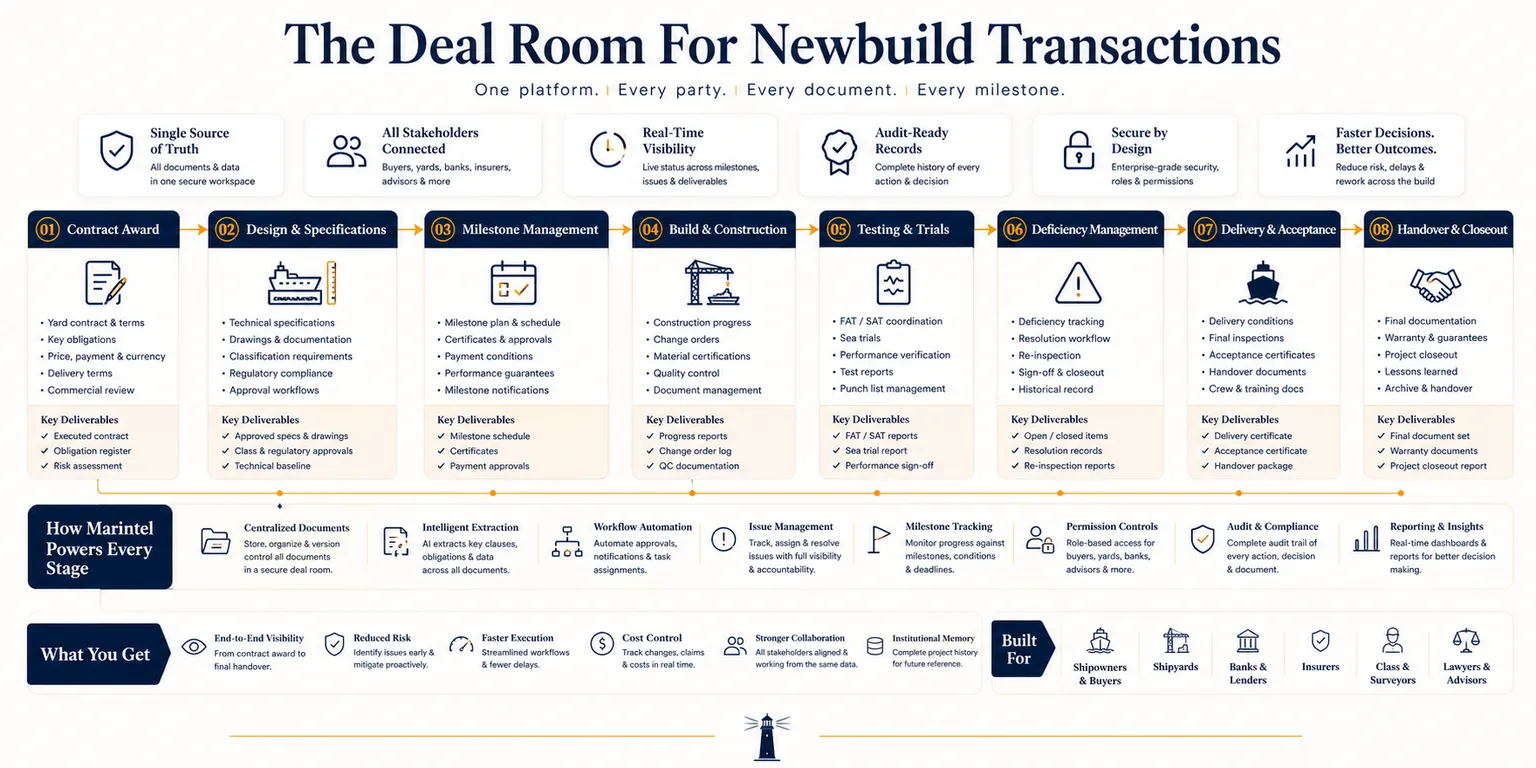
How to use this guide
A newbuild from contract to delivery is a 2-4 year journey, depending on yard, vessel type, and complexity. The documentary trail accumulates throughout. This guide walks the full sequence.
- New to newbuild? Read Quick Reference Timeline and Before You Start, then walk each phase.
- Working a specific phase? Use the table of contents.
- Working a non-merchant vessel? Asset-type sections within each phase cover offshore production (FPSO/FSO/FLNG), drilling rigs, passenger ships, and inland vessels.
Table of contents
- Quick Reference Timeline
- Before You Start
- Phase NB-1: Pre-Contract / LOI
- Phase NB-2: Contract Signing (T=0)
- Phase NB-3: Steel Cutting
- Phase NB-4: Keel Laying
- Phase NB-5: Launching / Float-Out
- Phase NB-6: Sea Trials & Commissioning
- Phase NB-7: Delivery & Acceptance
- Phase NB-8: Post-Delivery / Warranty
- Delivery Day Deep Dive
- Marintel-Generated Artifacts
- Common Failure Modes
Quick Reference Timeline
A standard merchant newbuild moves through eight phases over 18-30 months from contract signing to delivery. Some yards and vessel types extend this materially (LNG carriers and FPSOs commonly run 30-36 months from contract to delivery; complex offshore production assets can exceed 48 months).
| Phase | Name | Typical timing | Key event |
|---|---|---|---|
| NB-1 | Pre-Contract / LOI | Months -6 to 0 | Letter of Intent or detailed proposal |
| NB-2 | Contract Signing (T=0) | T=0 | SBC and RG executed |
| NB-3 | Steel Cutting | Months +3 to +6 | First steel cut at yard |
| NB-4 | Keel Laying | Months +6 to +12 | Vessel's keel laid on the blocks |
| NB-5 | Launching / Float-Out | Months +12 to +20 | Vessel floats for the first time |
| NB-6 | Sea Trials & Commissioning | Months +18 to +28 | Performance trials at sea |
| NB-7 | Delivery & Acceptance | T+18 to T+30 | Vessel handed over to owner |
| NB-8 | Post-Delivery / Warranty | T+18 to T+36 (post-delivery) | 12-month warranty period |
Before You Start: Predicates and Asset Types
Just like S&P, newbuild documents are filtered through predicates set at deal creation. The same six predicates apply:
| Predicate | Newbuild relevance |
|---|---|
vessel_type | Drives technical specifications, class notation, vetting requirements |
asset_class | Determines contract form (SBC vs EPCI vs SUPPLYTIME vs other) |
financed | Triggers loan agreement, RG, stage payment workflow |
flag_change | Generally no for newbuilds (vessel is registered at delivery on intended flag) |
sub_type_filters | DP class, ice class, IGC carrier, MODU class - drive specific certifications |
operating_jurisdiction | Production / drilling vessels in specific waters trigger jurisdiction-specific requirements |
Asset type variations - critical for newbuild
Different asset classes use materially different contract forms. The wrong contract base for the wrong asset class produces a deal that doesn't fit the asset.
Merchant Trading newbuilds
The standard case. SBC (Shipbuilding Contract) under SAJ form (Shipbuilders' Association of Japan), NEWBUILDCON (BIMCO), or similar. Tanker, bulker, container, general cargo, gas carrier, chemical tanker, reefer, Ro-Ro, vehicle carrier.
This guide is primarily written for merchant trading newbuilds. The phase structure and document set described here apply directly.
Offshore Production (FPSO / FSO / FLNG)
Production assets are typically built under EPCI (Engineering, Procurement, Construction, Installation) contracts, NOT standard SBCs. The "newbuild" is actually a conversion (where built from a tanker hull) or a purpose-built newbuild.
Key differences from merchant newbuild:
- EPCI Contract instead of SBC
- Charter agreement with the eventual oil-major operator (Petrobras, Equinor, BP, etc.) often signed before the EPCI - effectively a pre-finance commitment
- Field Development Plan from the oil-major operator
- Topsides Design Approval - separate class regime from hull approval
- Mooring System Certificate (turret, spread mooring, dynamic positioning)
- MWS (Marine Warranty Surveyor) attended at multiple build stages
- Decommissioning bond / plan often regulator-required
- Typical project length: 30-48 months from contract to first oil
- Sea trials may be replaced by integrated systems acceptance test (ISAT) at fabrication yard
- Newbuild milestones (NB-3, NB-4, NB-5) become Block Assembly, Topsides Integration, Hookup-and-Commissioning
Drilling Rigs (drill ships / semi-submersibles)
Drilling rigs operate under IMO MODU Code, not standard SOLAS. The newbuild contract is between drilling contractor and yard, with E&P operator typically not directly involved.
Key differences:
- MODU Code certification rather than full SOLAS suite
- Drilling Contract may be pre-arranged with E&P operator (drilling-rig newbuilds are typically tied to a specific operator's commitment)
- Well Control Equipment Certification (BOP, riser)
- Variable Deck Load Certificate
- DP Class Certificate (DP-2 or DP-3 typical for drill ships)
- Typical project length: 36-48 months
- Coast Guard COCs required for US GoM operations
- Operator-specific Safety Case (UK HSE, NORSOK) where region applies
Passenger Ships (cruise / ferry / Ro-Pax / HSC)
Passenger ships have stringent statutory regimes throughout build. The phase structure is similar but certificate requirements at delivery are different.
Key differences:
- Passenger Ship Safety Certificate (PSSC) replaces Cargo Ship Safety Certificate
- Damage Stability Information Booklet developed during build
- SOLAS 2009/2017 damage stability calculations completed and approved
- Lifesaving Appliance Plan & Capacity Calculation
- Muster List & Emergency Plan
- Onboard Medical Center Equipment List (cruise)
- Public Health Certificate (USPH for US-calling ships)
- Concessions / Cabin / F&B Service Agreements (cruise) - operational handover at delivery
- HSC Code Certificate for high-speed craft
- Typical project length: 24-36 months for ferries; 30-48 months for cruise ships
Offshore Support (AHTS / PSV / OSV / CTV / SOV)
OSV newbuilds use BIMCO SUPPLYTIME 2017 or WINDTIME (for offshore wind work) where charter is pre-arranged. Build phase otherwise similar to merchant.
Key differences:
- SUPPLYTIME 2017 charter party may be signed pre-newbuild contract
- WINDTIME for offshore wind operations
- DP Class Certificate where applicable (DP-1 / DP-2 / DP-3)
- Fi-Fi (Fire Fighting) Class Notation Certificate
- Oil Recovery / Oil Spill Response Equipment List (for spill-response vessels)
- Bollard Pull Certificate (AHTS specific) - measured at sea trials
- Crane Certification & Lifting Plan (PSV / construction vessels)
- HUET Training Records for crew operational handover
- Typical project length: similar to merchant (18-24 months)
Inland Vessels (CESNI / Subchapter M)
Inland regimes differ materially. Newbuild process is shorter and simpler.
Key differences:
- Inland Navigation Certificate replaces standard flag registration
- ADN Certificate (Dangerous Goods - inland) where carrying dangerous cargo
- Inland-Specific Tonnage Certificate (CCR / RNR for Rhine; equivalent for other rivers)
- Bridge Air-Draft Certificate often required
- Standard SOLAS suite typically not applicable
- Typical project length: 12-18 months
Phase NB-1: Pre-Contract / LOI
When this happens: Months -6 to 0 before SBC signing. The owner has identified a need; the yard has been approached; specifications are being negotiated.
Goal: Reach contractual readiness. Owner satisfies themselves the yard can deliver; yard satisfies itself the owner has financial capacity.
Phase gate to advance: Both parties agree to SBC execution.
Mandatory documents (NB-1)
D001 - Letter of Intent (LOI) / Heads of Agreement
- Purpose: Initial agreement framework. Outlines main commercial terms before the formal SBC is drafted.
- Contents: Vessel type and approximate specifications, hull number (provisional), yard, target delivery date, contract price (initial), payment structure outline, governing law, intended class society and flag, exclusivity period, conditions for moving to SBC.
- Issued by: Both parties (typically as a non-binding term sheet, sometimes binding). Why mandatory at NB-1: Without LOI, parties have no framework for the eventual SBC negotiation. (
asset_class = merchant_tradingtypically; offshore production / drilling may use a different commitment instrument.)
Recommended documents (NB-1)
- D006 Charter Party Description - existing charter terms (where newbuild is being financed against a charter commitment)
- D007 Yard Quotation / Builder's Proposal - the yard's commercial proposal with specifications and pricing
- D008 Charter Party with Purchase Option / Bareboat with Purchase Obligation - particularly common in Japanese leasing structures
- D020 Approval in Principle (AIP) - class society's preliminary approval of the design concept
- D230 Bank Comfort Letter / Proof of Funds - owner's bank's preliminary indication of capability
Asset-type variations
Offshore Production at NB-1
For FPSO / FSO / FLNG, NB-1 typically requires:
- Charter Contract with oil-major operator (signed or near-signed before EPCI)
- Field Development Plan
- Topsides Design Concept Approval (from class)
- Mooring system feasibility study
- Operator's Capex sanction
Drilling at NB-1
Drilling rig newbuilds typically have:
- LOI with intended E&P operator (where rig is being built for specific contract)
- Drilling Contract Term Sheet
- Class AIP for MODU Code
- DP capability concept assessment
Phase NB-2: Contract Signing (T=0)
When this happens: Single day. T=0. The moment from which the newbuild project clock runs.
Goal: Execute the SBC and supporting documentation. Establish financing, banking relationships, refund guarantees. Set up the structural and operational framework for 18-30 months of build work.
Phase gate to advance: SBC executed, RG in place, financing committed (where financed=yes).
This is the heaviest documentation phase by count (~36 docs). Documentation extends across contract, schedules, financing, corporate, sanctions, and class.
Mandatory documents (NB-2)
D002 - Shipbuilding Contract (SBC)
- Purpose: The contract governing the entire newbuild project. The legal centerpiece. Most newbuild SBCs are based on SAJ form (Japan), NEWBUILDCON (BIMCO), or yard-specific forms.
- Contents: Yard name, buyer name, hull number, vessel type, approximate dimensions and DWT, contract price and currency, contract form basis (SAJ / NEWBUILDCON / yard-specific), execution date, effective date, target delivery date, cancelling date (date past which buyer can cancel for delay), liquidated damages structure (per day rate, cap days), performance warranty (speed in knots, consumption in MT/day), class society, class notation, flag state intended, payment stages (typically 5-6), RG issuing bank, governing law, dispute resolution venue.
- Issued by: Both parties. Why mandatory at NB-2: No SBC, no newbuild.
- Marintel handles: Template ingestion from BIMCO SmartCon or yard form. Extraction of all 20+ critical fields. Validation against companion docs (RG, Loan Agreement, AIP).
D010 - Technical Specifications
- Purpose: The detailed technical specification of the vessel - what's being built.
- Contents: General arrangement, hull form, propulsion, fuel systems, cargo handling, navigation, communication, accommodation, classification details, maker's list reference.
- Issued by: Yard (drafted from buyer's requirements). Why mandatory at NB-2: The SBC references the spec; build must conform to it.
D011 - Maker's List
- Purpose: The list of approved equipment manufacturers for the vessel.
- Contents: Equipment categories and approved makers for each. Owner-side choices often dictate this; some yard-side dictation also typical.
- Issued by: Yard (negotiated with owner). Why mandatory at NB-2: Specifies the building blocks of the vessel.
D012 - Refund Guarantee (RG)
- Purpose: Bank guarantee that the yard will refund all stage payments made if the SBC is rescinded, cancelled, or terminated. Protects the owner's stage payments.
- Contents: Issuing bank, guaranteed buyer entity, yard name, hull number, SBC reference, guaranteed amount, currency, guarantee stage (which payment stages it covers), issue date, expiry date, assignability to lenders, governing law.
- Issued by: Yard's bank (Korean banks - K-Sure, Korea Eximbank; Chinese policy banks - CEXIM; etc.). Why mandatory at NB-2: Without RG, owner has no protection against yard default. Critical when yards delay or fail.
- Marintel validates: RG expiry date provides at least 6-month buffer beyond delivery date. Yard name and hull number match SBC. Principal amount matches stage payments. Bank is on approved list.
D014 - Payment / Stage Payment Schedule
- Purpose: The schedule of stage payments tied to milestone evidence and RGs.
- Contents: Each payment stage (typically 4-7 stages), amount, milestone trigger, evidence required, RG covering that stage.
- Issued by: Yard (per SBC). Why mandatory at NB-2: Defines the cash flow of the entire build project.
D015 - Delivery / Critical Path Schedule
- Purpose: The schedule of major milestones from contract to delivery.
- Issued by: Yard. Why mandatory at NB-2: Defines what happens when. Late milestones trigger LD provisions in SBC.
D021 - Class Notation Proposal
- Purpose: Proposed class notation for the vessel.
- Issued by: Class society. Why mandatory at NB-2: Required for class plan approval to begin.
D022 - Plan Approval Letters / Stamps
- Purpose: Class society's approval of design plans (lines plan, structural drawings, machinery plans, etc.).
- Issued by: Class society. Why mandatory at NB-2: Construction cannot begin without class-approved plans.
D074 - Builders Risk Insurance (newbuild)
- Purpose: Insurance covering the vessel and yard during construction.
- Issued by: Marine underwriter. Why mandatory at NB-2: Yard requires this; owner often requires this; bank requires this where financed.
D075 - Construction All Risk (CAR) Policy
- Purpose: Complementary risk cover for construction site, equipment, and progress.
- Issued by: Marine underwriter. Why mandatory at NB-2: Same as Builders Risk; broader scope.
D190 - Loan Agreement
- Purpose: Owner's loan agreement with their financing bank.
- Issued by: Bank + borrower. Why mandatory at NB-2: Required when
financed = yes. Without loan, owner cannot make stage payments.
D201 - Conditions Precedent (CP) Checklist
- Purpose: Bank's CP list for first drawdown.
- Issued by: Bank. Why mandatory at NB-2: Bank will not disburse until CPs satisfied. (
financed=yes.)
Corporate Documents (M-rated at NB-2)
The buyer (owning) SPV needs its corporate house in order before the SBC can be signed.
- D220 Certificate of Incorporation - SPV exists
- D221 Memorandum & Articles of Association - SPV has powers to enter SBC
- D226 Board Resolution authorising Transaction - SPV's board has authorised the newbuild
- D242 AML / KYC Package - bank-required (when financed)
- D245 Source of Funds Declaration - bank-required (when financed)
- D233 Tax Forms (FATCA / CRS Self-Certification) - bank-required (when financed)
Recommended documents (NB-2)
- D222 Certificate of Good Standing - SPV in good standing
- D223 Register of Directors - identifies authorised individuals
- D224 Register of Shareholders - SPV ownership structure
- D228 Specimen Signatures - signature authority
- D203 Fee Letters - bank fee structures
- D240 Sanctions Screening Confirmation - counterparty screening
- D248 ESG Disclosures / Certifications - increasingly required by lenders
Optional documents (NB-2)
| ID | Document | When relevant |
|---|---|---|
| D202 | Hedging Agreements | Interest rate or FX hedging |
| D206 | Escrow Agreement | Where stage payments routed via escrow |
| D208 | Letter of Credit | Where LC is part of payment structure |
| D209 | Bank Guarantee (non-RG) | Additional credit support |
| D229 | Parent Company Guarantee | Where SPV is thin |
| D241 | OFAC Representations | Where US sanctions exposure relevant |
| D243 | PEP Screening | Where applicable |
| D246 | Country-Exposure Declaration | Where applicable |
| D280-D282 | Correspondence and drafts | Preserved for audit |
Phase NB-3: Steel Cutting
When this happens: Months +3 to +6 after contract. The first steel for the vessel is cut at the yard.
Goal: Confirm construction has commenced. Trigger the first major stage payment. Document the yard's work.
Phase gate to advance: Steel Cutting Certificate received and validated; stage payment made; ongoing surveyor attendance established.
Mandatory documents (NB-3)
D040 - Steel Cutting Certificate
- Purpose: Yard's certification that steel cutting has commenced for the vessel.
- Contents: Hull number, yard name, certificate date, surveyor attendance (class), signatory.
- Issued by: Yard. Why mandatory at NB-3: Triggers the first major stage payment. Marks the vessel's physical existence.
D034 - Material / Mill Certificates
- Purpose: Certificates of conformity for the steel and major materials being used.
- Issued by: Steel mills, class-attended. Why mandatory at NB-3: Class society requires these to confirm material quality conforms to class rules.
D057 - Drawdown Certificate (per milestone)
- Purpose: Bank's certificate confirming the milestone-triggered drawdown is appropriate.
- Issued by: Bank. Why mandatory at NB-3: Required for stage payment disbursement. (
financed=yes.)
D200 - Drawdown Notice / Request
- Purpose: Owner's notice to bank requesting drawdown for the stage payment.
- Issued by: Buyer. Why mandatory at NB-3: Required for stage payment. (
financed=yes.)
Recommended documents (NB-3)
- D005 Side Letters & Addenda - parties' side agreements
- D032 Non-Conformance Reports (NCRs) - class society's NCRs raised during steel cutting
- D033 Surveyor Attendance Reports - class society's surveyor reports
- D051 Monthly Progress Reports - yard's project status reports
- D055 Change Order Register - any changes to the SBC
Phase NB-4: Keel Laying
When this happens: Months +6 to +12 after contract. The vessel's keel is laid on the blocks - the formal moment construction begins.
Goal: Trigger keel-laying stage payment. Begin block assembly. Coordinate Owner-Furnished Equipment (OFE).
Phase gate to advance: Keel Laying Certificate received; OFE schedule confirmed.
Mandatory documents (NB-4)
D041 - Keel Laying Certificate
- Purpose: Yard's certification that the keel has been laid - a formal IMO Convention reference point (vessel's "age" for some regulatory purposes calculates from keel laying or alternative date).
- Issued by: Yard. Why mandatory at NB-4: Triggers the keel-laying stage payment. Establishes the formal construction start date for SOLAS/MARPOL phase-in calculations.
D053 - Owner-Furnished Equipment (OFE) Schedule
- Purpose: Schedule of equipment to be supplied by the owner rather than the yard. Common items: communications equipment, paint, specific cargo handling gear.
- Issued by: Owner. Why mandatory at NB-4: Yard cannot integrate OFE without the schedule.
D054 - OFE Test Certificates & Manuals
- Purpose: Test certificates and manuals for the OFE equipment.
- Issued by: OFE suppliers. Why mandatory at NB-4: Class society requires these before fitment to vessel.
Recommended documents (NB-4)
- D052 Block Assembly Progress Reports / Photos - photographic record of block assembly
Phase NB-5: Launching / Float-Out
When this happens: Months +12 to +20 after contract. The vessel floats for the first time.
Goal: Mark physical completion of the hull's primary structure. Trigger launching stage payment.
Phase gate to advance: Launching Certificate received.
Mandatory documents (NB-5)
D042 - Launching Certificate
- Purpose: Yard's certification that the vessel has been launched (or floated out in the case of dock construction).
- Issued by: Yard. Why mandatory at NB-5: Triggers the launching stage payment.
Recommended documents (NB-5)
- D080 Provisional / Under-Construction Registration - some flags issue provisional registration at launching to facilitate trial trials, etc.
Phase NB-6: Sea Trials & Commissioning
When this happens: Months +18 to +28 after contract. The vessel is at sea undergoing performance tests.
Goal: Confirm vessel performance matches SBC specifications. Identify defects for rectification before delivery. Final commissioning of systems.
Phase gate to advance: Sea trials complete; punch list managed; vessel ready for delivery.
Mandatory documents (NB-6)
D013 - Performance Test Program / Performance Warranty
- Purpose: The test program defining what tests will be conducted and the warranty conditions.
- Contents: Speed trial parameters, consumption trial parameters, vibration tests, maneuvering tests, endurance tests, warranty thresholds.
- Issued by: Yard (per SBC). Why mandatory at NB-6: Defines what successful sea trials look like. Performance warranty in SBC depends on test results.
D023 - Interim Class Certificate (during build)
- Purpose: Class society's interim certificate confirming class status before the Full Term Certificate is issued at delivery.
- Issued by: Class society. Why mandatory at NB-6: Required for vessel to undertake sea trials.
D043 - Inclining Experiment Protocol & Report
- Purpose: The inclining experiment determines the vessel's lightship weight and centre of gravity. Required for stability calculations.
- Issued by: Yard / surveyor / class society. Why mandatory at NB-6: Stability calculations depend on this. Without it, the vessel cannot trade.
D044 - Sea Trial Protocols
- Purpose: Detailed protocols for each sea trial test (speed, consumption, vibration, maneuvering).
- Issued by: Yard / surveyors. Why mandatory at NB-6: Documents that trials were properly conducted.
D045 - Sea Trial Results / Test Records
- Purpose: Recorded results from each sea trial.
- Contents: Speed achieved, consumption measured, vibration levels, maneuvering performance. Compared against warranty thresholds in SBC.
- Issued by: Yard / surveyors. Why mandatory at NB-6: Without results, no acceptance of performance.
D046 - Punch List / Defect List
- Purpose: List of defects, deficiencies, and non-conformances identified during sea trials and final inspection.
- Issued by: Yard / owner's inspector. Why mandatory at NB-6: Punch list must be cleared (or deferred items agreed) before delivery.
D108 - SOPEP / SMPEP
- Purpose: Shipboard Oil Pollution Emergency Plan (SOPEP) or Shipboard Marine Pollution Emergency Plan (SMPEP). Required by MARPOL.
- Issued by: Vessel manager / yard. Why mandatory at NB-6: Required for vessel trading.
Asset-type variations
Offshore Production at NB-6
FPSO sea trials may be replaced by Integrated Systems Acceptance Test (ISAT) at fabrication yard. Performance is measured against production capacity rather than transit speed.
Additional documents:
- Topsides Integration Test results
- Mooring System Test results
- Risk Analysis (HAZID / HAZOP / FMEA) reports
- MWS Sea Trials Reports
Drilling at NB-6
Drill ship sea trials include DP system tests, BOP integration tests, riser tests, drilling system functional tests.
Additional documents:
- DP Capability Plot (final, post-trials)
- BOP Function Test Reports
- Variable Deck Load Test Results
Phase NB-7: Delivery & Acceptance
When this happens: Months +18 to +30 after contract. Single day or two-day event.
Goal: Transfer the vessel from yard to owner. Update Marintel's ownership ledger (vessel created). Trigger Marintel-Generated Artifacts.
Phase gate to advance: Builder's Certificate + PODA Accepted; ledger writes fire; M001 Closing Certificate issued.
Marintel handles: The closing-event bridge fires automatically at NB-7. See Delivery Day Deep Dive below.
This is the heaviest documentation phase of newbuild (~65 docs converging at delivery). Below are the most critical.
The Title Transfer Documents
D047 - Builder's Certificate
- Purpose: The yard's certification that the vessel has been built per the SBC and is ready for delivery. The "newbuild Bill of Sale" equivalent.
- Contents: Vessel IMO, name, hull number, yard name, yard country, build year, delivery date, vessel type, DWT, GT, NT, class society and notation, buyer/owner entity (named as "for the account of"), SBC reference (date and parties), place of issue, date of issue, yard signatory name and title, notary or consular legalisation.
- Issued by: Yard. Why mandatory at NB-7: Title transfer document for newbuild. Marintel's vessel master record is created when this is Accepted.
- Marintel validates: Vessel IMO matches IMO Assignment doc. Hull number, yard name, SBC reference match D002 SBC. Vessel dimensions match Tonnage Cert. Class society and notation match D024 Class Cert.
D172 - Protocol of Delivery and Acceptance (newbuild)
- Purpose: Joint protocol confirming the yard has delivered and the buyer has accepted the vessel. Time-stamped to the second.
- Contents: Vessel IMO, hull number, yard entity, buyer entity, delivery date, time, location, yard signatory, buyer signatory, punch list status (all cleared OR list of deferred items), SBC reference.
- Issued by: Both parties co-execute. Why mandatory at NB-7: Without it, the title doesn't transfer.
Vessel Particulars and IMO Assignment
D060 / D061 - Q88 (tanker) / Vessel Particulars Sheet (non-tanker)
- Purpose: The vessel's identification document (see SP-1 descriptions).
- Issued by: Vessel manager (post-delivery, with owner). Why mandatory at NB-7: Required from delivery for vessel trading.
D062 - Tonnage Certificate
- Purpose: Official tonnage certification.
- Issued by: Flag state or class society. Why mandatory at NB-7: Required for trading.
D063 - Load Line Certificate
- Issued by: Class society. Why mandatory at NB-7: Required for trading.
D064 - IMO Number Assignment Documentation
- Purpose: IMO's assignment of the unique 7-digit IMO number to the vessel.
- Issued by: IMO. Why mandatory at NB-7: Required for all vessel registration and identification.
Class & Survey at Delivery
D024 - Classification Certificate (Full Term)
- Purpose: Class society's full-term classification certificate (5-year cycle starts at delivery).
- Issued by: Class society. Why mandatory at NB-7: Required for trading.
D035 - Ship Construction File (SCF) - bulk carriers
- Purpose: SCF required for bulk carriers under SOLAS XII.
- Issued by: Class society. Why mandatory at NB-7: Required by SOLAS XII for bulk carriers.
Insurance at Delivery
- D070 H&M Certificate / Cover Note (M) - hull and machinery insurance
- D071 P&I Certificate of Entry (M) - P&I cover
- D072 War Risk Cover Note (R) - war risk
- D076 Mortgagee Endorsements / Loss Payable Clauses (M) - bank named as loss payee (financed)
- D077 Notice of Assignment of Insurance (Acknowledgement) (M) - underwriter's acknowledgement
Flag & Registration at Delivery
- D081 Permanent Certificate of Registry (M) - the formal registration
- D083 Continuous Synopsis Record (CSR) (M) - vessel's continuous record
- D084 Minimum Safe Manning Certificate (M) - crew requirements
- D085 Ship Station Licence (M) - radio licence
- D086 Application for Registration (M) - the application document
- D087 Ownership Declaration / Tonnage Declaration (M) - owner declarations
- D088 Flag State Mortgage Consent (M) - mortgage consent (financed)
- D090 Mortgage Registration Acknowledgement (M) - flag's confirmation of mortgage
Statutory Certificates at Delivery (all M at NB-7)
The full SOLAS / MARPOL / ISM / ISPS / MLC suite must be in place by delivery. Each issued by class society on behalf of flag, or directly by flag.
- D100 IOPP Certificate
- D101 IAPP Certificate
- D102 Ballast Water Management Certificate
- D103 ISPP Certificate (Sewage)
- D104 Anti-Fouling System Certificate
- D105 International Energy Efficiency (IEE) Certificate
- D106 EEXI Technical File & Certificate
- D109 Cargo Ship Safety Construction Certificate
- D110 Cargo Ship Safety Equipment Certificate
- D111 Cargo Ship Safety Radio Certificate
- D112 Document of Compliance (DOC) - issued to managing company
- D113 Safety Management Certificate (SMC) - issued to vessel
- D114 International Ship Security Certificate (ISSC)
- D115 Maritime Labour Certificate (MLC)
- D116 Ship Sanitation Control Certificate
Newbuild Acceptance Documents
- D048 Warranty Declaration (12-month) (M) - yard's warranty undertaking
- D049 No-encumbrance / Lien Release Certificate (M) - confirms yard has paid all subcontractors
- D050 Spare Parts Inventory (M) - inventory of spare parts handed over
- D056 Yard Final Invoice & Accounts Reconciliation (M) - final commercial reconciliation
- D058 Lien Waivers (from yard / subcontractors) (M) - waivers ensuring no liens against vessel
Financing Security Package (all M at NB-7, all trigger on financed=yes)
Same as S&P SP-5 financing package:
- D191 First Preferred Ship Mortgage
- D192 Deed of Covenant
- D193 Assignment of Earnings
- D194 Assignment of Insurances
- D195 Charter Assignment (where applicable)
- D196 Account Pledge Agreement
- D197 Share Pledge (over SPV)
- D198 Manager's Undertaking
- D199 General Assignment
- D210 Funding Confirmation / SWIFT Confirmation
Corporate at Delivery
- D225 Incumbency Certificate (M) - confirms signatory authority
- D227 Power of Attorney (M) - where attorney-in-fact signs
Closing Mechanics
- D260 Closing Memorandum / Closing Agenda (M) - master agenda
- D261 Acceptance Memorandum (M) - acceptance memo
- D262 Signature Tracker (R) - live signature status
- D263 Apostille / Notarisation Tracker (R) - notarisation tracking
- D264 Funds / SWIFT Tracker (R) - payment flow tracking
- D265 CP Satisfaction List (M) - CP completion list
Other M-rated documents at NB-7
- D173 Notice of Readiness (NOR) (R) - notice that yard is ready to deliver
- D234 Manager Appointment Agreement (M) - vessel manager identified
Recommended documents (NB-7)
- D092 Vessel Naming / Re-Naming Certificate - vessel naming formalisation (where flag issues separately from Certificate of Registry)
- D231 Shareholders' Agreement - over the buyer SPV
- D232 Joint Venture Agreement - multi-party ownership
Phase NB-8: Post-Delivery / Warranty
When this happens: Months 18-24 after delivery. The 12-month yard warranty period.
Goal: Resolve any post-delivery defects through warranty. Begin vessel's regular operational lifecycle.
Phase gate to advance: Warranty period completes; outstanding warranty claims resolved.
Mandatory documents (NB-8)
D107 - CII Rating Statement
- Purpose: Carbon Intensity Indicator rating - annual measurement of vessel's carbon efficiency.
- Issued by: Annual basis from flag/class. Why mandatory at NB-8: Required by IMO MARPOL Annex VI as of 2023.
Optional documents (NB-8)
- D027 Annual Survey Report - first annual survey post-delivery
- D030 Continuous Machinery Survey Records - rolling machinery surveys
Delivery Day Deep Dive
Newbuild delivery day, like S&P closing day, is choreography. The sequence matters; timestamps matter; Marintel orchestrates.
Typical sequence
- Day before: Final pre-delivery inspection. Punch list reviewed. All M-rated documents in Accepted state.
- 08:00 UTC delivery day: Pre-delivery meeting. Yard confirms readiness; owner confirms readiness.
- 10:00 UTC: Spare parts inventory verified. D050 cross-checked.
- 11:00 UTC: Final commercial reconciliation. D056 yard invoice agreed.
- 12:00 UTC: NOR tendered by yard. D173 time-stamped.
- 12:30 UTC: Both parties sign PODA. D172 time-stamped.
- 13:00 UTC: Builder's Certificate executed. D047 time-stamped.
- 13:01 UTC: Marintel validates D047 against SBC, IMO Assignment, Class Cert.
- 13:02 UTC: Closing-event bridge fires. Marintel creates vessel master record (D047 is the vessel's "birth event" in the ledger). New ownership_ledger entry inserted: buyer SPV = owner from delivery_date.
- 13:03 UTC: M001 Closing Certificate and M002 Ownership Snapshot issued and cryptographically signed.
- 13:05 UTC: Mortgage instruments executed (financed case).
- 13:10 UTC: Funds released to yard. D210 SWIFT confirmation issued.
- 13:15 UTC: Permanent Certificate of Registry issued by flag (or pending; provisional may apply if registration application was filed earlier).
- 14:00 UTC: Owner takes operational control. Vessel flies new (buyer-side) flag.
What goes wrong
- Punch list dispute. Yard claims punch items deferred; owner claims they're delivery conditions. Resolution: negotiate deferred items list with timeline.
- Performance warranty trigger. Sea trial results show speed or consumption below warranty thresholds. Resolution: SBC has LD provisions; potentially price reduction or extended warranty.
- RG / payment dispute. Yard claims certain stage payments aren't due; owner has paid them. Resolution: RG can be partially called against; rare but happens.
- Class condition. Class issues vessel with a condition at delivery. Resolution: condition documented; vessel can still deliver but conditions must be cleared per class timeline.
- Bank funding delay. Final drawdown blocked because a CP isn't satisfied. Resolution: clear the CP or accept partial funding; common cause is missing apostille on a corporate document.
Marintel-Generated Artifacts
At NB-7 delivery, when the closing-event bridge fires, Marintel emits the same four signed artifacts that S&P deals generate (see S&P guide artifacts section):
- M001 Closing Certificate - signed proof of delivery
- M002 Ownership Snapshot - point-in-time view of vessel ownership (now: buyer SPV)
- M003 Audit Log Export - hash-chained event log
- M004 Validation Reports - per-document AI provenance
The key difference from S&P artifacts: M002 Ownership Snapshot for a newbuild captures the moment of vessel creation. There is no prior ownership history; this snapshot is the foundational entry.
Common Failure Modes
Yard delay leading to RG expiry
A multi-year newbuild project runs over schedule. The Refund Guarantee expires before delivery. Owner is exposed if yard then defaults.
Mitigation: D012 RG validation in Marintel checks expiry date provides minimum 6-month buffer beyond delivery date. Alerts when buffer narrows.
Performance warranty failure
Sea trials show vessel underperforms against warranty thresholds (speed, consumption). Owner has rights under SBC but the yard pushes back.
Mitigation: Marintel preserves the sea trial protocols (D044) and results (D045) as signed evidence. Disputes go to arbitration with clear documentation.
Class condition at delivery
Vessel delivered with a class condition. While trading is technically permitted, the condition affects vessel value and operational flexibility.
Mitigation: Conditions of class documented in D024 Class Cert validation. Marintel surfaces these prominently; owner addresses promptly.
IMO Number Assignment lag
IMO number not assigned at delivery; vessel cannot perfect flag registration. Provisional certificates may be issued meanwhile.
Mitigation: IMO assignment typically arranged 3-6 months before delivery via flag state. Marintel surfaces dependency.
Subcontractor lien
A subcontractor claims unpaid debts against the vessel. Without lien waivers (D058), the buyer takes the vessel subject to the lien.
Mitigation: Marintel requires lien waivers as part of NB-7 mandatory document set. Cannot close without them.
Flag state delay
The intended flag state is slow to issue the Permanent Certificate of Registry at delivery. Provisional may apply.
Mitigation: Plan flag-state engagement early; D086 Application for Registration submitted at NB-6 (not NB-7) to give registry time.
Manager dispute
Vessel manager isn't ready at delivery (crew not transferred, ISM/ISPS systems not operational). Vessel can be delivered but cannot trade.
Mitigation: D198 Manager's Undertaking and D234 Manager Appointment Agreement signed by NB-7. Marintel surfaces manager readiness as a closing condition.